Data Structures and Algorithms
- Introduction to Data Structures and Algorithms
- Time and Space Complexity Analysis
- Big-O, Big-Theta, and Big-Omega Notations
- Recursion and Backtracking
- Divide and Conquer Algorithm
- Dynamic Programming: Memoization vs. Tabulation
- Greedy Algorithms and Their Use Cases
- Understanding Arrays: Types and Operations
- Linear Search vs. Binary Search
- Sorting Algorithms: Bubble, Insertion, Selection, and Merge Sort
- QuickSort: Explanation and Implementation
- Heap Sort and Its Applications
- Counting Sort, Radix Sort, and Bucket Sort
- Hashing Techniques: Hash Tables and Collisions
- Open Addressing vs. Separate Chaining in Hashing
- DSA Questions for Beginners
- Advanced DSA Questions for Competitive Programming
- Top 10 DSA Questions to Crack Your Next Coding Test
- Top 50 DSA Questions Every Programmer Should Practice
- Top Atlassian DSA Interview Questions
- Top Amazon DSA Interview Questions
- Top Microsoft DSA Interview Questions
- Top Meta (Facebook) DSA Interview Questions
- Netflix DSA Interview Questions and Preparation Guide
- Top 20 DSA Interview Questions You Need to Know
- Top Uber DSA Interview Questions and Solutions
- Google DSA Interview Questions and How to Prepare
- Airbnb DSA Interview Questions and How to Solve Them
- Mobile App DSA Interview Questions and Solutions
DSA Interview Questions
- DSA Questions for Beginners
- Advanced DSA Questions for Competitive Programming
- Top 10 DSA Questions to Crack Your Next Coding Test
- Top 50 DSA Questions Every Programmer Should Practice
- Top Atlassian DSA Interview Questions
- Top Amazon DSA Interview Questions
- Top Microsoft DSA Interview Questions
- Top Meta (Facebook) DSA Interview Questions
- Netflix DSA Interview Questions and Preparation Guide
- Top 20 DSA Interview Questions You Need to Know
- Top Uber DSA Interview Questions and Solutions
- Google DSA Interview Questions and How to Prepare
- Airbnb DSA Interview Questions and How to Solve Them
- Mobile App DSA Interview Questions and Solutions
Data Structures and Algorithms
- Introduction to Data Structures and Algorithms
- Time and Space Complexity Analysis
- Big-O, Big-Theta, and Big-Omega Notations
- Recursion and Backtracking
- Divide and Conquer Algorithm
- Dynamic Programming: Memoization vs. Tabulation
- Greedy Algorithms and Their Use Cases
- Understanding Arrays: Types and Operations
- Linear Search vs. Binary Search
- Sorting Algorithms: Bubble, Insertion, Selection, and Merge Sort
- QuickSort: Explanation and Implementation
- Heap Sort and Its Applications
- Counting Sort, Radix Sort, and Bucket Sort
- Hashing Techniques: Hash Tables and Collisions
- Open Addressing vs. Separate Chaining in Hashing
- DSA Questions for Beginners
- Advanced DSA Questions for Competitive Programming
- Top 10 DSA Questions to Crack Your Next Coding Test
- Top 50 DSA Questions Every Programmer Should Practice
- Top Atlassian DSA Interview Questions
- Top Amazon DSA Interview Questions
- Top Microsoft DSA Interview Questions
- Top Meta (Facebook) DSA Interview Questions
- Netflix DSA Interview Questions and Preparation Guide
- Top 20 DSA Interview Questions You Need to Know
- Top Uber DSA Interview Questions and Solutions
- Google DSA Interview Questions and How to Prepare
- Airbnb DSA Interview Questions and How to Solve Them
- Mobile App DSA Interview Questions and Solutions
DSA Interview Questions
- DSA Questions for Beginners
- Advanced DSA Questions for Competitive Programming
- Top 10 DSA Questions to Crack Your Next Coding Test
- Top 50 DSA Questions Every Programmer Should Practice
- Top Atlassian DSA Interview Questions
- Top Amazon DSA Interview Questions
- Top Microsoft DSA Interview Questions
- Top Meta (Facebook) DSA Interview Questions
- Netflix DSA Interview Questions and Preparation Guide
- Top 20 DSA Interview Questions You Need to Know
- Top Uber DSA Interview Questions and Solutions
- Google DSA Interview Questions and How to Prepare
- Airbnb DSA Interview Questions and How to Solve Them
- Mobile App DSA Interview Questions and Solutions
Mock System Design Interview: How to Design Amazon Prime Video (Step-by-Step)
Preparing for a system design interview can feel overwhelming, especially when you’re asked to architect a massive platform like Amazon Prime Video. Whether you’re aiming for a role at a tech giant or just honing your skills, this guide walks you through it step by step. If you’re eager to dive deeper into system design concepts, sign up for our free course updates to receive the latest tips, resources, and exclusive content tailored for aspiring engineers.
In this blog post, we’ll simulate a mock system design interview focused on building Amazon Prime Video from scratch. We’ll cover everything from requirements gathering to scalability challenges, drawing on real-world insights and best practices. By the end, you’ll have a solid framework to tackle similar questions, plus actionable advice to boost your interview performance. Let’s get started—think of this as your personal walkthrough, complete with tips from experts who’ve navigated FAANG-level interviews.
Introduction to System Design Interviews
System design interviews test your ability to architect large-scale, reliable systems under constraints like high traffic and low latency. Unlike coding problems, these are open-ended, evaluating your problem-solving, communication, and trade-off analysis. For a service like Amazon Prime Video, interviewers expect you to handle complexities such as global content delivery and personalized recommendations.
Amazon Prime Video, launched in 2006, has grown into a powerhouse with over 230 million users worldwide as of 2024 projections. It generates around $13.5 billion in revenue annually, with content spending hitting $21.5 billion to fuel originals and licensed shows. The platform serves billions of streaming hours, emphasizing why designs must prioritize availability (99.99% uptime) and efficiency.
To prepare, familiarize yourself with core concepts like distributed systems, microservices, and caching. Resources like our Master DSA, Web Dev, and System Design course can help build that foundation. Now, let’s dive into the mock interview process.
Understanding Amazon Prime Video’s Core Features
Before designing, grasp what makes Prime Video tick. It’s not just video playback—it’s a full ecosystem including user authentication, content discovery, and offline downloads. Key stats highlight the scale:
- Over 240 million global subscribers, with 185 million in the US alone.
- Users consume about 1-7 GB per hour depending on resolution, leading to massive data throughput.
Peak traffic can hit millions of concurrent streams, especially during events like live sports.
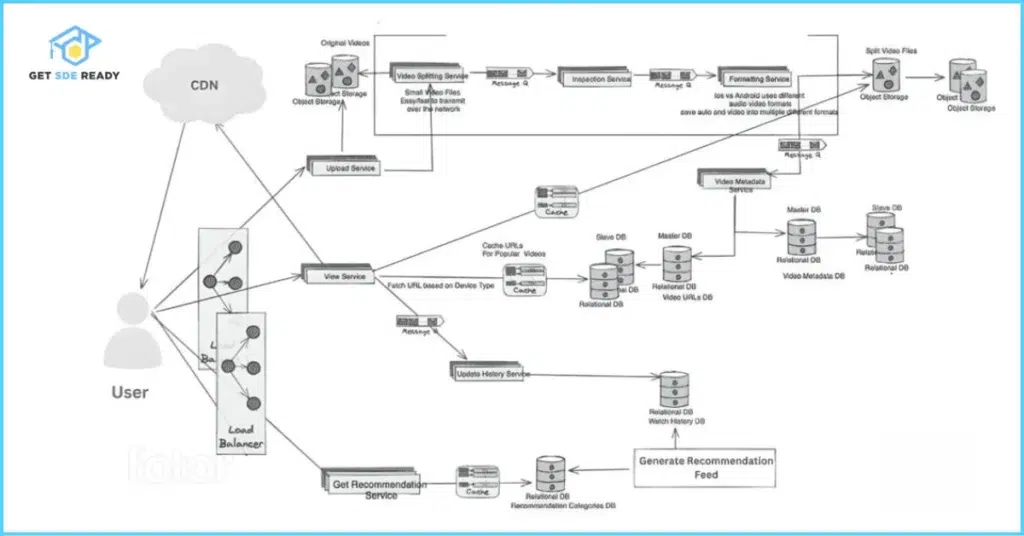
Prime Video relies on AWS infrastructure for scalability, but in an interview, you’ll design it agnostically. Common challenges include minimizing buffering (low latency) and handling geo-distributed users.
Step 1: Clarify Requirements and Scope
Every system design starts with questions—don’t jump to diagrams. Ask the interviewer to define scope: “Are we focusing on video streaming, recommendations, or the full platform?” For Prime Video, clarify:
Functional Requirements
- User authentication and subscription management (e.g., login, plan selection).
- Content upload, processing, and storage.
- Video playback with controls (play, pause, rewind) and adaptive streaming.
- Search, recommendations, and watchlists.
- Offline downloads and multi-device sync.
Non-Functional Requirements
- Scalability: Handle 100 million monthly users, scaling to peaks of 500 million requests per second.
- Availability: 99.99% uptime with eventual consistency for non-critical data like view counts.
- Low Latency: <200ms for recommendations; minimal buffering via adaptive bitrate.
- Reliability: No data loss for uploaded videos; fault-tolerant with redundancy.
- Security: Encryption for streams, compliance with privacy laws.
Estimate resources: Assume 100 million users watching 30 minutes daily, leading to ~2.57 videos played per second and petabytes of storage. This sets the stage for distributed architecture.
Tip: Use the RESHADED framework (Requirements, Estimation, Storage, High-level, API, Detailed, Evolution, Dependencies) to structure your response.
Step 2: High-Level Design (HLD)
Outline the big picture: Break Prime Video into microservices for modularity. Key components interact via APIs, with data flowing through load balancers and queues.
Key Components
- User Service: Handles authentication, profiles, and subscriptions. Uses relational DB like PostgreSQL for user data.
- Content Upload Service: Processes uploads, generates pre-signed URLs for direct S3-like storage.
- Video Processing Service: Encodes videos into multiple formats (e.g., 480p, 4K) using workers on queues like Kafka. Stores segments in object storage.
- Recommendation Service: Analyzes viewing history with ML models for personalized feeds. Integrates with Elasticsearch for search.
- Streaming Service: Delivers content via CDN, supporting HLS/DASH protocols for adaptive streaming.
- Databases: NoSQL (Cassandra) for metadata; SQL for relational info like watchlists.
CDN: Caches content at edge locations to reduce latency.

Data Flow:
- User uploads video → Upload Service → Object Storage.
- Processing queue triggers encoding → Split into segments.
- User requests playback → View Service fetches metadata → CDN serves segments.
Trade-offs: Microservices add complexity but enable independent scaling. Prioritize availability over strong consistency for recommendations.
Step 3: Low-Level Design (LLD)
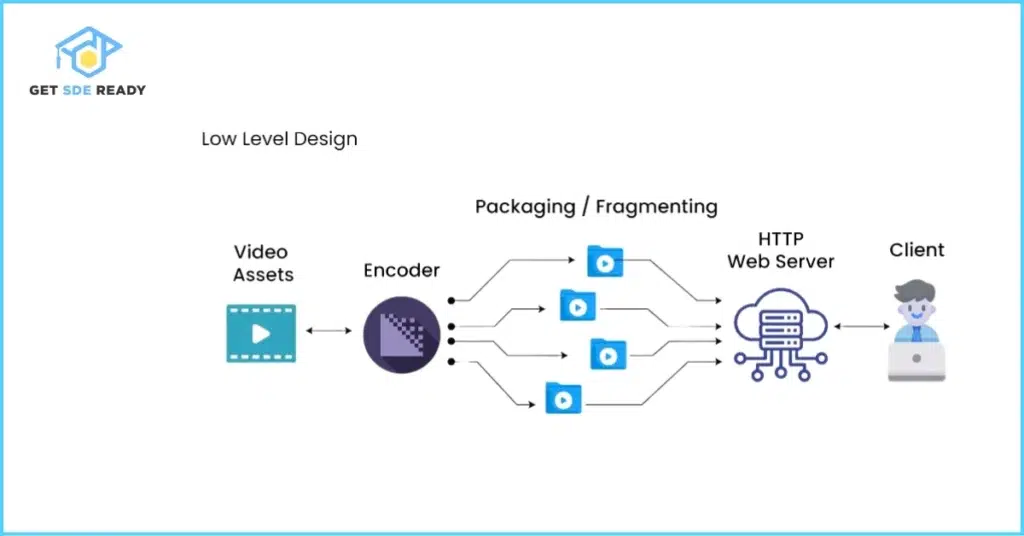
Drill down into specifics. For video streaming:
Video Processing Pipeline
- Encoder: Compresses raw video into formats like H.264.
- Fragmenting: Breaks into 2-10 second chunks for adaptive delivery.
- HTTP Server: Serves chunks; client requests based on bandwidth.
APIs: e.g., POST /api/video/upload for uploads; GET /api/recommendations for feeds.
Database Schema (example):
- User Table: user_id (PK), username, email, password.
- Video Table: video_id (PK), title, duration, upload_date.
- Watchlist Table: watchlist_id (PK), user_id (FK), video_id (FK).
For scalability, shard databases by user_id and use caching (Redis) for hot content.
Scalability and Performance Considerations
To handle Prime Video’s scale:
- Load Balancing: Distribute traffic evenly; use global balancers for geo-routing.
- Caching: Multi-tier (edge, regional) with LRU eviction for popular videos.
- Fault Tolerance: Replicate data across regions; use circuit breakers like Hystrix.
- Monitoring: Tools like Prometheus for metrics; auto-scale with Kubernetes.

Challenges: Cold starts for new content—pre-cache based on trends. Cost optimization: Tiered storage for rarely accessed videos.
Link this to broader skills: Mastering data structures is key for efficient algorithms here—check our DSA course for more.
30 Common System Design Interview Questions and In-Depth Answers
System design interviews often include follow-ups or related questions. Here are 30 real questions asked in FAANG interviews (sourced from actual experiences), with in-depth answers focused on streaming contexts. These build on Prime Video design principles.
- Design a Distributed Metrics Logging System (Asked at Google)
Answer: Build a system like Prometheus for monitoring Prime Video streams. Use Kafka for ingestion, Elasticsearch for storage, and aggregators for real-time dashboards. Scale with sharding; ensure fault tolerance via replication. Detailed: Ingest logs from edge servers, process with Spark for aggregation, query via SQL-like interface. Trade-off: Eventual consistency for speed vs. accuracy. - Design a Distributed Stream Processing System like Kafka (Asked at Amazon)
Answer: For real-time analytics in Prime Video (e.g., view counts), use partitioned topics for scalability. Brokers handle persistence; consumers pull data. In-depth: Zookeeper for coordination, replication for HA. Handle backpressure with buffering; integrate with Flink for processing. - Design a Key-Value Store (Asked at Apple)
Answer: Like DynamoDB for metadata storage. Use consistent hashing for partitioning, quorum reads/writes for consistency. In-depth: Handle failures with hinted handoff; cache hot keys in Memcached. - Identify the K Most Shared Articles (Asked at LinkedIn)
Answer: For trending videos, use a heap or sorted set in Redis for top-K. Aggregate shares via Kafka streams. In-depth: Time windows with sliding aggregates; scale by sharding counters. - Design an API Rate Limiter (Asked at Amazon)
Answer: Protect Prime Video APIs from abuse using token bucket algorithm in Redis. In-depth: Distributed with sliding windows; enforce per-user limits to prevent DDoS. - System to Collect Performance Metrics from Servers (Asked at Google)
Answer: Agent-based collection (e.g., Telegraf) pushing to InfluxDB. In-depth: Aggregate with downsampling; alert on thresholds for streaming latency. - Design Google Analytics Dashboard (Asked at Microsoft)
Answer: Pipeline with Kafka ingestion, Spark processing, and Tableau viz. In-depth: Real-time vs. batch; handle PII with anonymization. - Design a System for Sorting Large Data Sets (Asked at Google)
Answer: Distributed sort like MapReduce for video rankings. In-depth: Partition data, merge-sort phases; optimize with sampling for pivots. - Top K Elements: App Store Rankings (Asked at Amazon)
Answer: Heavy hitters algorithm (Count-Min Sketch) for top videos. In-depth: Probabilistic with error bounds; update in streams. - Design Dropbox or Google Drive (Asked at Google)
Answer: For video storage, chunked uploads to S3, metadata in Dynamo. In-depth: Sync with delta updates; version control for edits. - Design a Job Scheduler (Asked at Amazon)
Answer: For video encoding jobs, use Kubernetes cron or Airflow. In-depth: Distributed locking with etcd; priority queues for urgency. - Design a Notification Service (Asked at Google)
Answer: Push notifications for new episodes via FCM. In-depth: Fanout with pub-sub; rate limit to avoid spam. - Surge Pricing System: Uber (Similar for Streaming Peaks, Asked at Uber)
Answer: Real-time ML on demand data; Kafka for events. In-depth: Geospatial indexing with Quadtrees. - Limit Screens per User (Asked at Netflix)
Answer: Track sessions in Redis; enforce via API gateway. In-depth: Heartbeats for liveness; geo-IP fallback. - Design ETA and Location Sharing (Asked at Uber)
Answer: For live streaming events, use WebSockets and Kalman filters. In-depth: Pub-sub for updates; privacy with token auth. - Design a Hotel Booking System (Asked at Amazon)
Answer: Analogous to subscription plans; use optimistic locking for availability. In-depth: Distributed transactions with Saga pattern. - Design an A/B Testing System (Asked at Affirm)
Answer: For UI variants in Prime app; random assignment via cookies. In-depth: Statistical significance with chi-square tests. - Design a Price Alert System (Asked at Facebook)
Answer: For subscription deals; cron jobs scanning prices. In-depth: Webhooks for real-time; user queues in RabbitMQ. - Design an IoC/Dependency Injection Framework (Asked at ADP)
Answer: For modular services; reflection-based wiring. In-depth: Singleton scopes; circular dependency detection. - Design a Credit Card Processing System (Asked at Stripe)
Answer: For payments; PCI-compliant with tokenization. In-depth: Idempotent ops; fraud detection with ML. - Count Facebook Likes (Asked at Facebook)
Answer: Distributed counters with sharding; eventual consistency. In-depth: Write-ahead logs for durability. - Design a Control Plane for Distributed DB (Asked at Netflix)
Answer: Like Vitess; metadata management with etcd. In-depth: Auto-sharding; query routing. - Develop a Weather Application (Asked at Amazon)
Answer: Real-time data pulls; caching for forecasts. In-depth: API aggregation from sources like OpenWeather. - Design a Scalable CDN (Asked at Netflix)
Answer: Hierarchical with edge caching; predictive pre-fetch. In-depth: LRU eviction; peering with ISPs. - Design a Fault-Tolerant Streaming Service (Asked at Netflix)
Answer: Replication across AZs; circuit breakers. In-depth: Chaos engineering for testing. - Design a Personalized Recommendation System (Asked at Netflix)
Answer: Collaborative filtering with Spark ML. In-depth: Cold-start handling; A/B testing integration. - Design a Low-Latency Streaming Service (Asked at Netflix)
Answer: Adaptive bitrate with DASH; chunked delivery. In-depth: Buffer optimization; network-aware routing. - Design an Advanced Search with Autocomplete (Asked at Netflix)
Answer: Elasticsearch with n-grams; personalized ranking. In-depth: Synonym handling; spell correction. - Design a URL Shortener (Common Follow-up)
Answer: Base62 encoding; distributed IDs. In-depth: Collision avoidance with hashing. - Design a News Feed System (Asked at Twitter)
Answer: For video feeds; fanout on write. In-depth: Hybrid push-pull; ranking with ML.
These questions draw from real interviews—practice them to deepen your understanding. For more on web development aspects, explore our Web Development course.
Conclusion
Designing Amazon Prime Video in a mock interview highlights the blend of creativity and technical rigor needed for scalable systems. Remember, communicate your thought process, justify trade-offs, and align with business needs like customer obsession. Ready to level up? Check our Data Science course for ML in recommendations or the Crash Course for quick prep. What system would you design next? Share in the comments!
FAQs
What is the system design for Amazon Prime Video?
Amazon Prime Video uses microservices, CDNs for low-latency streaming, and ML for recommendations, ensuring scalability for millions of users.
How to prepare for system design interviews like designing streaming services?
Focus on requirements, high-level architecture, scalability, and practice with mock questions on distributed systems and caching strategies.
What are key components in video streaming architecture?
Essential elements include encoders, fragmenters, CDNs, databases for metadata, and services for uploads, processing, and personalization.
Why is CDN important in Amazon Prime Video design?
CDNs reduce latency by caching content at edge servers, improving playback quality and handling global traffic efficiently.
DSA, High & Low Level System Designs
- 85+ Live Classes & Recordings
- 24*7 Live Doubt Support
- 400+ DSA Practice Questions
- Comprehensive Notes
- HackerRank Tests & Quizzes
- Topic-wise Quizzes
- Case Studies
- Access to Global Peer Community
Buy for 52% OFF
₹25,000.00 ₹11,999.00
Accelerate your Path to a Product based Career
Boost your career or get hired at top product-based companies by joining our expertly crafted courses. Gain practical skills and real-world knowledge to help you succeed.
Data Analytics
- 20+ Live Classes & Recordings
- 24*7 Live Doubt Support
- 15+ Hands-on Live Projects
- Comprehensive Notes
- Real-world Tools & Technologies
- Access to Global Peer Community
- Interview Prep Material
- Placement Assistance
Buy for 70% OFF
₹9,999.00 ₹2,999.00
SDE 360: Master DSA, System Design, AI & Behavioural
- 100+ Live Classes & Recordings
- 24*7 Live Doubt Support
- 400+ DSA Practice Questions
- Comprehensive Notes
- HackerRank Tests & Quizzes
- Topic-wise Quizzes
- Case Studies
- Access to Global Peer Community
Buy for 50% OFF
₹39,999.00 ₹19,999.00
Fast-Track to Full Spectrum Software Engineering
- 120+ Live Classes & Recordings
- 24*7 Live Doubt Support
- 400+ DSA Practice Questions
- Comprehensive Notes
- HackerRank Tests & Quizzes
- 12+ live Projects & Deployments
- Case Studies
- Access to Global Peer Community
Buy for 51% OFF
₹35,000.00 ₹16,999.00
DSA, High & Low Level System Designs
- 85+ Live Classes & Recordings
- 24*7 Live Doubt Support
- 400+ DSA Practice Questions
- Comprehensive Notes
- HackerRank Tests & Quizzes
- Topic-wise Quizzes
- Case Studies
- Access to Global Peer Community
Buy for 52% OFF
₹25,000.00 ₹11,999.00
Mastering Mern Stack (WEB DEVELOPMENT)
- 65+ Live Classes & Recordings
- 24*7 Live Doubt Support
- 12+ Hands-on Live Projects & Deployments
- Comprehensive Notes & Quizzes
- Real-world Tools & Technologies
- Access to Global Peer Community
- Interview Prep Material
- Placement Assistance
Buy for 53% OFF
₹15,000.00 ₹6,999.00
Mastering Data Structures & Algorithms
- 65+ Live Classes & Recordings
- 24*7 Live Doubt Support
- 400+ DSA Practice Questions
- Comprehensive Notes
- HackerRank Tests
- Access to Global Peer Community
- Topic-wise Quizzes
- Interview Prep Material
Buy for 40% OFF
₹9,999.00 ₹5,999.00
Reach Out Now
If you have any queries, please fill out this form. We will surely reach out to you.
Contact Email
Reach us at the following email address.
arun@getsdeready.com
Phone Number
You can reach us by phone as well.
+91-97737 28034
Our Location
Rohini, Sector-3, Delhi-110085