Data Structures and Algorithms
- Introduction to Data Structures and Algorithms
- Time and Space Complexity Analysis
- Big-O, Big-Theta, and Big-Omega Notations
- Recursion and Backtracking
- Divide and Conquer Algorithm
- Dynamic Programming: Memoization vs. Tabulation
- Greedy Algorithms and Their Use Cases
- Understanding Arrays: Types and Operations
- Linear Search vs. Binary Search
- Sorting Algorithms: Bubble, Insertion, Selection, and Merge Sort
- QuickSort: Explanation and Implementation
- Heap Sort and Its Applications
- Counting Sort, Radix Sort, and Bucket Sort
- Hashing Techniques: Hash Tables and Collisions
- Open Addressing vs. Separate Chaining in Hashing
- DSA Questions for Beginners
- Advanced DSA Questions for Competitive Programming
- Top 10 DSA Questions to Crack Your Next Coding Test
- Top 50 DSA Questions Every Programmer Should Practice
- Top Atlassian DSA Interview Questions
- Top Amazon DSA Interview Questions
- Top Microsoft DSA Interview Questions
- Top Meta (Facebook) DSA Interview Questions
- Netflix DSA Interview Questions and Preparation Guide
- Top 20 DSA Interview Questions You Need to Know
- Top Uber DSA Interview Questions and Solutions
- Google DSA Interview Questions and How to Prepare
- Airbnb DSA Interview Questions and How to Solve Them
- Mobile App DSA Interview Questions and Solutions
DSA Interview Questions
- DSA Questions for Beginners
- Advanced DSA Questions for Competitive Programming
- Top 10 DSA Questions to Crack Your Next Coding Test
- Top 50 DSA Questions Every Programmer Should Practice
- Top Atlassian DSA Interview Questions
- Top Amazon DSA Interview Questions
- Top Microsoft DSA Interview Questions
- Top Meta (Facebook) DSA Interview Questions
- Netflix DSA Interview Questions and Preparation Guide
- Top 20 DSA Interview Questions You Need to Know
- Top Uber DSA Interview Questions and Solutions
- Google DSA Interview Questions and How to Prepare
- Airbnb DSA Interview Questions and How to Solve Them
- Mobile App DSA Interview Questions and Solutions
Data Structures and Algorithms
- Introduction to Data Structures and Algorithms
- Time and Space Complexity Analysis
- Big-O, Big-Theta, and Big-Omega Notations
- Recursion and Backtracking
- Divide and Conquer Algorithm
- Dynamic Programming: Memoization vs. Tabulation
- Greedy Algorithms and Their Use Cases
- Understanding Arrays: Types and Operations
- Linear Search vs. Binary Search
- Sorting Algorithms: Bubble, Insertion, Selection, and Merge Sort
- QuickSort: Explanation and Implementation
- Heap Sort and Its Applications
- Counting Sort, Radix Sort, and Bucket Sort
- Hashing Techniques: Hash Tables and Collisions
- Open Addressing vs. Separate Chaining in Hashing
- DSA Questions for Beginners
- Advanced DSA Questions for Competitive Programming
- Top 10 DSA Questions to Crack Your Next Coding Test
- Top 50 DSA Questions Every Programmer Should Practice
- Top Atlassian DSA Interview Questions
- Top Amazon DSA Interview Questions
- Top Microsoft DSA Interview Questions
- Top Meta (Facebook) DSA Interview Questions
- Netflix DSA Interview Questions and Preparation Guide
- Top 20 DSA Interview Questions You Need to Know
- Top Uber DSA Interview Questions and Solutions
- Google DSA Interview Questions and How to Prepare
- Airbnb DSA Interview Questions and How to Solve Them
- Mobile App DSA Interview Questions and Solutions
DSA Interview Questions
- DSA Questions for Beginners
- Advanced DSA Questions for Competitive Programming
- Top 10 DSA Questions to Crack Your Next Coding Test
- Top 50 DSA Questions Every Programmer Should Practice
- Top Atlassian DSA Interview Questions
- Top Amazon DSA Interview Questions
- Top Microsoft DSA Interview Questions
- Top Meta (Facebook) DSA Interview Questions
- Netflix DSA Interview Questions and Preparation Guide
- Top 20 DSA Interview Questions You Need to Know
- Top Uber DSA Interview Questions and Solutions
- Google DSA Interview Questions and How to Prepare
- Airbnb DSA Interview Questions and How to Solve Them
- Mobile App DSA Interview Questions and Solutions
Difference Between SDE-1, SDE-2, and SDE-3 Interview Levels Explained
Navigating the world of software development engineer (SDE) roles can feel overwhelming, especially when you’re trying to figure out where you fit in the hierarchy. Whether you’re a fresh graduate eyeing an entry-level position or a seasoned coder aiming for senior roles, understanding the distinctions between SDE-1, SDE-2, and SDE-3 interview levels is key to targeted preparation. If you’re serious about leveling up your skills, sign up for our free course updates and exclusive resources to get ahead in your tech career journey.
Understanding SDE Levels in Tech Companies
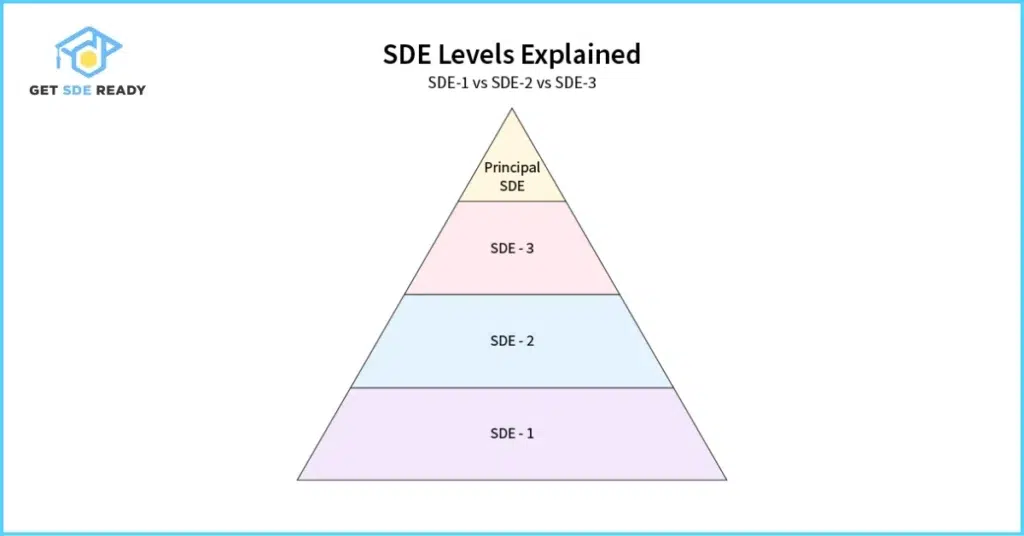
Software Development Engineer levels, often abbreviated as SDE-1, SDE-2, and SDE-3, represent a progression in expertise, responsibility, and impact within tech organizations like Amazon, Microsoft, and Google. These designations aren’t universal—companies may use titles like Junior Software Engineer for SDE-1 or Senior Software Engineer for SDE-3—but the core differences revolve around experience, problem-solving depth, and leadership.
What is an SDE-1 Role?
SDE-1 is typically the entry point for new graduates or those with up to 2 years of experience. At this level, you’re expected to execute tasks efficiently under guidance, focusing on building foundational skills.
- Key Responsibilities: Implementing code from design specs, writing test cases, debugging issues, and collaborating on small features. SDE-1s often follow established processes and seek mentorship for complex problems.
- Required Skills: Strong basics in programming languages (e.g., Java, Python), data structures, and algorithms. Problem-solving is key, but it’s more about accuracy than innovation.
- Experience Level: 0-2 years. Freshers might start here after internships.
According to a Masai School analysis, SDE-1s “create complex solutions to simple problems,” emphasizing learning and execution over strategy.
What is an SDE-2 Role?
SDE-2, often called Senior Software Engineer, marks a shift toward independence. With 3-5 years of experience, you’re owning features end-to-end and mentoring juniors.
- Key Responsibilities: Designing and implementing scalable solutions, identifying bottlenecks, training new hires, and ensuring code maintainability. SDE-2s handle service ownership and adapt to changing requirements.
- Required Skills: Advanced coding, design patterns (e.g., OOP, DRY principles), and system-level thinking. You need to balance efficiency with robustness.
- Experience Level: 3-5 years. Promotions from SDE-1 come after demonstrating consistent impact.
Experts note that SDE-2s “create simple solutions to simple problems,” focusing on efficiency and team collaboration.
What is an SDE-3 Role?
SDE-3, or Principal/Lead Software Engineer, is a leadership-focused role for those with 5+ years of experience. Here, you’re driving major decisions and influencing cross-team strategies.
- Key Responsibilities: Architecting large-scale systems, handling non-functional requirements (e.g., scalability, security), mentoring SDE-1s and SDE-2s, and aligning tech with business goals. SDE-3s identify inefficiencies and build reusable frameworks.
- Required Skills: Deep knowledge of distributed systems, SOA, and leadership. Soft skills like communication are crucial for stakeholder interactions.
- Experience Level: 5+ years. This level requires a “bird’s-eye view” of operations.
As per industry insights, SDE-3s “create simple solutions to complex problems,” blending technical prowess with strategic insight.
Statistics show that interview success rates for these roles hover around 15-20% at companies like Amazon, underscoring the need for thorough prep.
Key Differences in Responsibilities and Expectations
While all SDE levels involve coding, the scope expands with seniority. Here’s a breakdown:
Aspect | SDE-1 | SDE-2 | SDE-3 |
Focus | Execution and learning | Ownership and mentorship | Leadership and architecture |
Problem Complexity | Basic to medium (e.g., implement features) | Medium to hard (e.g., optimize systems) | Hard to expert (e.g., scalable designs) |
Team Role | Contributor | Key player and mentor | Lead and strategist |
Impact | Individual tasks | Team-level features | Organization-wide systems |
Salary Range (US Avg.) | $120K-$150K | $150K-$200K | $200K+ |
SDE-1s might fix bugs using logs, while SDE-3s design systems preventing them. Progression isn’t automatic—it’s based on demonstrated performance, with only about 47.5% of candidates advancing through interviews overall.
The Interview Process: How It Differs by Level
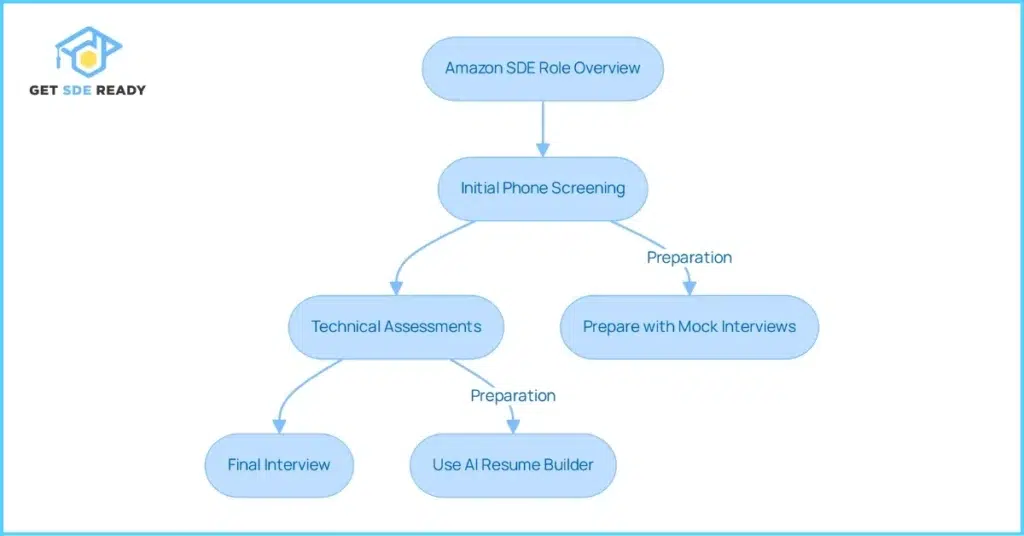
Interviews at tech giants like Amazon, Microsoft, and Google typically include online assessments, coding rounds, system design, and behavioral questions. The emphasis shifts with the level.
SDE-1 Interview Focus
Entry-level interviews test fundamentals. Expect 2-4 rounds emphasizing coding and basics.
- Coding Rounds: LeetCode-style problems (easy-medium).
- Behavioral: Basic “tell me about yourself” and teamwork examples.
- No/Light System Design: Rare, focusing on simple implementations.
Tip: Practice DSA basics. For web development roles, check out our web development courses to build a strong foundation.
SDE-2 Interview Focus
Mid-level interviews assess independence. 3-5 rounds, with more design emphasis.
- Coding Rounds: Medium-hard problems, plus adaptability.
- System Design: Low-level (e.g., OOP-based designs).
- Behavioral: Leadership principles, using STAR method.
Amazon’s SDE-2 prep highlights writing clean, testable code and clarifying requirements.
SDE-3 Interview Focus
Senior interviews evaluate leadership. 4-6 rounds, heavy on design and strategy.
- Coding Rounds: Complex, efficient solutions.
- System Design: High-level (e.g., distributed systems).
- Behavioral: Deep dives into decisions and failures.
Amazon notes SDE-3s must demonstrate scalability and stakeholder alignment.
Overall, pass rates drop with level—entry-level might see 30-50%, while senior roles are under 20%.
Real Interview Questions Asked in SDE Interviews
To give you real value, here are 30+ actual questions reported from Amazon, Microsoft, and Google interviews, distributed by level. I’ve included in-depth explanations and solutions based on standard approaches. These come from Glassdoor reports and prep resources—practice them on platforms like LeetCode.
SDE-1 Level Questions (Focus: Basics and Implementation)
- Largest Sum Contiguous Subarray (Amazon) Problem: Find the maximum sum of a contiguous subarray. Solution: Use Kadane’s algorithm. Initialize max_current and max_global to the first element. For each subsequent element, update max_current = max(arr[i], max_current + arr[i]), then max_global = max(max_global, max_current). Time: O(n), Space: O(1). Why asked: Tests array manipulation and dynamic programming basics.
- Search in a Row-wise and Column-wise Sorted Matrix (Microsoft) Problem: Search for an element in a sorted 2D matrix. Solution: Start from top-right. If target < current, move left; if >, move down. Continue until found or out of bounds. Time: O(m+n). Why asked: Evaluates binary search variants.
- Print a Given Matrix in Spiral Form (Google) Problem: Traverse a matrix spirally. Solution: Use four pointers (top, bottom, left, right). Print layers outward, shrinking boundaries. Handle single row/column cases. Time: O(m*n). Why asked: Checks boundary handling.
- Program for Array Rotation (Amazon) Problem: Rotate array by d elements. Solution: Use reversal: Reverse [0..d-1], [d..n-1], then whole array. Time: O(n). Why asked: Optimizes space over naive shifts.
- Trapping Rain Water (Microsoft) Problem: Calculate trapped water between bars. Solution: Precompute left/right max heights. For each bar, add min(left_max, right_max) – height. Time: O(n). Why asked: Real-world application of arrays.
- Count Pairs with Given Sum (Google) Problem: Count pairs summing to k. Solution: Use hashmap for frequency. For each num, add count[k-num] (subtract if same). Time: O(n). Why asked: Hashing efficiency.
- Validate an IP Address (Amazon) Problem: Check valid IPv4. Solution: Split by ‘.’, check 4 parts, each 0-255, no leading zeros. Why asked: String parsing skills.
- Reverse a Linked List (Microsoft) Problem: Reverse singly linked list. Solution: Iterative: Three pointers (prev, curr, next). Update curr.next = prev. Time: O(n). Why asked: Linked list basics.
- Detect Loop in a Linked List (Google) Problem: Check for cycle. Solution: Floyd’s cycle detection (slow/fast pointers). If meet, cycle exists. Time: O(n). Why asked: Pointer manipulation.
- Nth Node from the End of Linked List (Amazon) Problem: Find nth from end. Solution: Two pointers, advance first by n, then move both until first reaches end. Time: O(n). Why asked: Efficient traversal.
SDE-2 Level Questions (Focus: Optimization and Design)
- Find Duplicates in an Array (Amazon) Problem: Find duplicates with O(1) space. Solution: Modify array as visited marker (negate values). If already negative, duplicate. Restore if needed. Time: O(n). Why asked: Space optimization.
- Multiply Strings (Microsoft) Problem: Multiply large numbers as strings. Solution: Simulate manual multiplication, handle carry. Use array for digits. Time: O(m*n). Why asked: Big integer handling.
- Implement Atoi (Google) Problem: String to int. Solution: Handle signs, overflow (clamp to INT_MIN/MAX), ignore non-digits after start. Why asked: Edge cases like overflow.
- Length of the Longest Substring Without Repeating Characters (Amazon) Problem: Find max unique substring length. Solution: Sliding window with set. Move left on duplicate. Time: O(n). Why asked: Window techniques.
- Merge K Sorted Linked Lists (Microsoft) Problem: Merge k lists. Solution: Min-heap of list heads. Pop min, add next. Time: O(n log k). Why asked: Priority queues.
- Add Two Numbers Represented by Linked Lists (Google) Problem: Add two numbers as lists. Solution: Traverse with carry, build new list. Handle unequal lengths. Time: O(max(m,n)). Why asked: List arithmetic.
- Search an Element in a Sorted and Rotated Array (Amazon) Problem: Search in rotated sorted array. Solution: Binary search variant. Find pivot, search appropriate half. Time: O(log n). Why asked: Modified binary search.
- Square Root of an Integer (Microsoft) Problem: Integer sqrt. Solution: Binary search from 1 to x/2. Time: O(log n). Why asked: Math optimization.
- Sort an Array of 0s, 1s, and 2s (Google) Problem: Sort 0-1-2 array. Solution: Dutch National Flag: Low/mid/high pointers. Swap based on mid. Time: O(n). Why asked: Partitioning.
- Check for Balanced Brackets in an Expression (Amazon) Problem: Validate brackets. Solution: Stack: Push open, pop on close if matches. Time: O(n). Why asked: Stack applications.
SDE-3 Level Questions (Focus: Scalability and Leadership)
- Diameter of a Binary Tree (Amazon) Problem: Longest path in tree. Solution: DFS: For each node, max(left_height + right_height). Update global max. Time: O(n). Why asked: Tree recursion.
- Lowest Common Ancestor in a Binary Tree (Microsoft) Problem: Find LCA. Solution: Recursive: If root is p/q, return root. Else recurse left/right, combine results. Time: O(n). Why asked: Tree traversal.
- Serialize and Deserialize a Binary Tree (Google) Problem: Tree to string and back. Solution: Preorder traversal with markers for null. Deserialize with queue. Time: O(n). Why asked: Serialization.
- Find the Number of Islands (Amazon) Problem: Count islands in grid. Solution: DFS/BFS on ‘1’s, mark visited. Count components. Time: O(m*n). Why asked: Graph connectivity.
- Topological Sort (Microsoft) Problem: Topo sort DAG. Solution: Kahn’s algo: Indegree array, queue zeros, reduce indegrees. Time: O(V+E). Why asked: Dependency resolution.
- K Largest Elements (Google) Problem: Find k largest. Solution: Min-heap of size k. Add if > root, replace. Time: O(n log k). Why asked: Heap usage.
- 0-1 Knapsack Problem (Amazon) Problem: Max value with weight limit. Solution: DP table: dp[i][w] = max(dp[i-1][w], dp[i-1][w-weight[i]] + value[i]). Time: O(n*W). Why asked: Classic DP.
- Longest Common Subsequence (Microsoft) Problem: LCS length. Solution: DP: If match, dp[i][j] = dp[i-1][j-1] + 1; else max(left, up). Time: O(m*n). Why asked: String DP.
- N-Queen Problem (Google) Problem: Place n queens safely. Solution: Backtracking: Place row-by-row, check columns/diagonals. Time: O(n!). Why asked: Backtracking.
- Design a System to Handle Millions of Requests per Second (Amazon) Problem: Scalable system design. Solution: Use load balancers, caching (Redis), sharding databases, microservices. Discuss trade-offs like consistency vs. availability (CAP theorem). Why asked: High-level design.
- Explain How You Would Optimize a Slow-Running SQL Query (Microsoft) Problem: Query optimization. Solution: Analyze EXPLAIN, add indexes, avoid SELECT *, join efficiently, limit rows. Use profiling tools. Why asked: Database knowledge.
- Design a Distributed Caching System (Google) Problem: Cache design. Solution: LRU eviction, consistent hashing for distribution, replication for fault tolerance. Handle cache misses with DB fallback. Why asked: Scalability.
- Tell Me About a Time You Had to Make a Decision with Incomplete Information (Amazon) Problem: Behavioral. Solution: Use STAR: Situation (project deadline), Task (choose tech), Action (research pros/cons, consult team), Result (successful launch). Why asked: Leadership.
- What is the Difference Between a Mutex and a Semaphore? (Microsoft) Problem: Concurrency. Solution: Mutex for mutual exclusion (ownership), semaphore for signaling (count-based). Mutex binary semaphore variant. Why asked: OS concepts.
- Describe a Challenging Project You Worked On and How You Overcame Challenges (Google) Problem: Behavioral. Solution: STAR: Scaling app, bottlenecks in DB, optimized queries/sharded, reduced latency 50%. Why asked: Experience reflection.
These questions are drawn from real reports—e.g., Glassdoor users mention similar ones in 2025 interviews.
Preparation Tips for Each SDE Level
Success demands targeted practice. Here’s actionable advice:
- For SDE-1: Grind 75 LeetCode problems. Focus on basics via our DSA courses. Mock interviews on Pramp.
- For SDE-2: Master OOP and low-level design. Read “System Design Interview” by Alex Xu. Enroll in master DSA, web dev, and system design for comprehensive prep.
- For SDE-3: Practice high-level designs. Use Grokking the System Design Interview. Explore data science courses for advanced analytics.
General tips: Use STAR for behavioral, include metrics. Practice 4-5 hours daily. For quick boosts, try our crash course.
Expert quote: “The chief difference is the time you have to solve the problem. No real-world problem has to be solved in 20 minutes,” notes a Quora contributor on interview vs. real work.
Common Mistakes to Avoid in SDE Interviews
- Jumping into code without clarifying requirements (common in SDE-2).
- Ignoring edge cases in coding.
- Weak behavioral stories—always tie to impact.
- Overlooking soft skills for SDE-3.
Avoid these by practicing mocks and reviewing failures.
Final Thoughts and Next Steps
Mastering SDE levels means aligning prep with expectations—fundamentals for SDE-1, ownership for SDE-2, leadership for SDE-3. With dedication, you can crack these interviews. Ready to accelerate? Explore our courses and start today.
FAQs
What are the main differences in coding questions between SDE-1 and SDE-2 interviews?
SDE-1 focuses on easy-medium DSA like arrays and linked lists, while SDE-2 emphasizes optimization, design patterns, and medium-hard problems.
How does system design vary across SDE levels?
SDE-1 rarely includes design; SDE-2 covers low-level (OOP); SDE-3 involves high-level scalable systems like distributed architectures.
What behavioral questions should I prepare for SDE-3 roles?
Expect deep dives into leadership, like “Tell me about a tough decision with limited info,” using STAR to show impact and growth.
Are there specific skills for Amazon SDE interviews?
Yes, align with Leadership Principles; practice coding without IDE and system design for scalability.

DSA, High & Low Level System Designs
- 85+ Live Classes & Recordings
- 24*7 Live Doubt Support
- 400+ DSA Practice Questions
- Comprehensive Notes
- HackerRank Tests & Quizzes
- Topic-wise Quizzes
- Case Studies
- Access to Global Peer Community
Buy for 52% OFF
₹25,000.00 ₹11,999.00
Accelerate your Path to a Product based Career
Boost your career or get hired at top product-based companies by joining our expertly crafted courses. Gain practical skills and real-world knowledge to help you succeed.
SDE 360: Master DSA, System Design, AI & Behavioural
- 100+ Live Classes & Recordings
- 24*7 Live Doubt Support
- 400+ DSA Practice Questions
- Comprehensive Notes
- HackerRank Tests & Quizzes
- Topic-wise Quizzes
- Case Studies
- Access to Global Peer Community
Buy for 50% OFF
₹39,999.00 ₹19,999.00

DSA, High & Low Level System Designs
- 85+ Live Classes & Recordings
- 24*7 Live Doubt Support
- 400+ DSA Practice Questions
- Comprehensive Notes
- HackerRank Tests & Quizzes
- Topic-wise Quizzes
- Case Studies
- Access to Global Peer Community
Buy for 52% OFF
₹25,000.00 ₹11,999.00
Fast-Track to Full Spectrum Software Engineering
- 120+ Live Classes & Recordings
- 24*7 Live Doubt Support
- 400+ DSA Practice Questions
- Comprehensive Notes
- HackerRank Tests & Quizzes
- 12+ live Projects & Deployments
- Case Studies
- Access to Global Peer Community
Buy for 51% OFF
₹35,000.00 ₹16,999.00
Low & High Level System Design
- 20+ Live Classes & Recordings
- 24*7 Live Doubt Support
- Case Studies
- Comprehensive Notes
- HackerRank Tests
- Topic-wise Quizzes
- Access to Global Peer Community
- Interview Prep Material
Buy for 60% OFF
₹20,000.00 ₹7,999.00

Mastering Mern Stack (WEB DEVELOPMENT)
- 65+ Live Classes & Recordings
- 24*7 Live Doubt Support
- 12+ Hands-on Live Projects & Deployments
- Comprehensive Notes & Quizzes
- Real-world Tools & Technologies
- Access to Global Peer Community
- Interview Prep Material
- Placement Assistance
Buy for 53% OFF
₹15,000.00 ₹6,999.00
Reach Out Now
If you have any queries, please fill out this form. We will surely reach out to you.
Contact Email
Reach us at the following email address.
arun@getsdeready.com
Phone Number
You can reach us by phone as well.
+91-97737 28034
Our Location
Rohini, Sector-3, Delhi-110085